
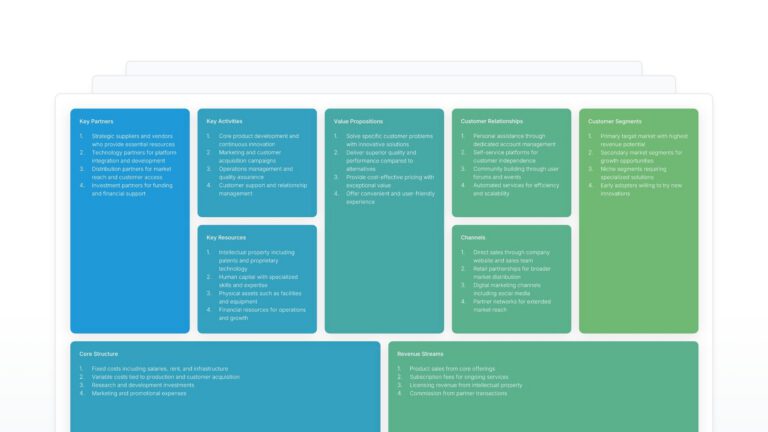
A founder’s cheat code: Lean Canvas explained with a real B2B SaaS example
📘
This article provides an insight into using the Lean Canvas for B2B SaaS startups.
Understanding Lean Canvas
Lean Canvas is an adaptation of the Business Model Canvas tailored for startups.
It helps entrepreneurs visualize their business model in a structured way.
Key Components
The canvas includes problem, customer segments, and unique value proposition.
Each section is crucial for outlining your startup strategy.
Example in Action
Consider a SaaS product designed for project management solutions.
Its unique value could be simplicity and integration with existing tools.
✅ Key Takeaways
- Lean Canvas structures business ideas.
- Focus on customer needs first.
- Iterate based on feedback quickly.
- Visualize challenges clearly.
- Align team towards shared objectives.
📌 Use Lean Canvas to pivot easily.
🎯 Mini Checklist
- Identify target customers.
- Define key problems to solve.
- Outline value propositions clearly.
- Test assumptions with real users.
- Revise canvas regularly.
Common Mistakes: Failing to update the canvas can hinder progress.
Final Thoughts: Lean Canvas is a game-changer for B2B SaaS founders.
FAQs
What is Lean Canvas?
It’s a one-page business model tool for startups.
Who should use it?
Entrepreneurs and startup teams seeking clarity.
How often should I update it?
Regularly, as you learn and adapt your model.
Meta: An overview of Lean Canvas for B2B startups.
business model
startup strategy
Lean Canvas



Leave a Reply